
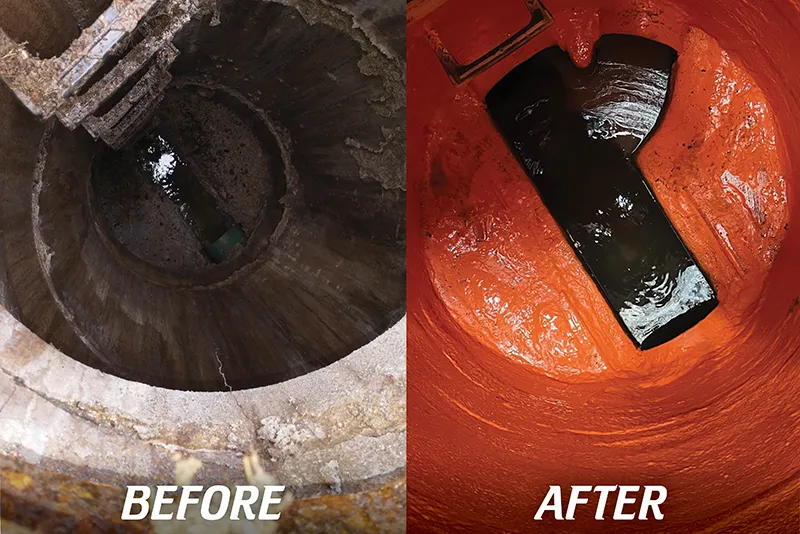
For municipalities across Illinois and Indiana, maintaining aging wastewater infrastructure has become a balancing act between protecting public assets and managing limited budgets. Isaiah Hale, Business Development Manager for Advanced Rehabilitation Technology (ART), said that in his service territory of Illinois and southern Indiana, municipalities are increasingly viewing manhole rehabilitation as a cost-effective alternative to full replacement that extends the life of existing infrastructure while minimizing excavation, traffic disruption, and long-term maintenance costs.
Why are Illinois and Indiana Municipalities Investing in Manhole Rehabilitation?
Much of the wastewater infrastructure throughout Illinois and Indiana was built decades ago and is now reaching an age where deterioration becomes increasingly common. While every municipality faces unique challenges, the goal remains the same: preserve existing infrastructure before failures become significantly more expensive to repair.
Rather than replacing entire structures, municipalities are choosing to rehabilitate existing manholes, lift stations, and other wastewater assets, as it allows communities to spread improvements over multiple budget cycles. This phased approach enables them to address their highest-priority structures today while planning future rehabilitation projects as funding becomes available.
How Infiltration and Inflow (I&I) Impact Wastewater Infrastructure
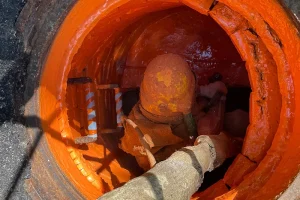
One of the biggest challenges municipalities face throughout southern Indiana and many parts of Illinois is infiltration and inflow (I&I). Groundwater enters deteriorated manholes through cracks, failed joints, deteriorated concrete, and damaged structures. Heavy rainfall and flooding can dramatically increase the amount of clean water entering sanitary sewer systems, forcing treatment plants to process water that should never have entered the system.
According to Isaiah, southern Indiana experiences significant flooding, while rocky soils and exposed concrete create additional opportunities for groundwater infiltration. Tree roots further contribute to deterioration by cracking concrete and separating joints, creating even more pathways for water to enter the collection system.
Operational factors also accelerate deterioration. As wastewater moves through force mains and lift stations, hydrogen sulfide gas develops within the system. Over time, H2S attacks concrete structures, weakening manholes and shortening their service life if left unprotected.
One of the biggest misconceptions municipalities face is assuming that small leaks are insignificant. In reality, even a minor leak can create substantial long-term operating costs. Isaiah stated that a leak of just one gallon per minute can cost a municipality approximately $1,300 to $1,500 each year in unnecessary wastewater treatment expenses. While one small leak may seem manageable, dozens of similar leaks throughout a collection system can add up quickly.
By rehabilitating deteriorated manholes before those leaks worsen, municipalities can significantly reduce infiltration while lowering treatment costs and improving the overall efficiency of their wastewater systems.
Why More Communities in Illinois and Indiana are Choosing Trenchless Rehabilitation Instead of Replacement
For many municipalities, replacing every deteriorated structure simply isn’t realistic. Budget limitations often require public works departments to prioritize projects and maximize every infrastructure dollar.
Isaiah said many communities choose to rehabilitate a portion of their system each year rather than attempting large-scale replacements all at once. A municipality may rehabilitate five to ten manholes one year, then continue improving additional structures as funding becomes available. This phased strategy allows municipalities to make measurable progress while staying within annual budgets.
The long-term return on investment can be significant. One example is the Village of Hamler, Ohio, where a phased rehabilitation program dramatically reduced infiltration over multiple years. By strategically rehabilitating priority manholes, the community reduced unnecessary flow into its wastewater system and created ongoing operational savings that could be reinvested into future infrastructure improvements.
As more municipalities recognize these financial benefits, and as additional state and federal infrastructure funding becomes available, rehabilitation continues to gain momentum throughout the Midwest
What Should Municipalities Look for in a Manhole Rehabilitation Contractor?
Selecting the right rehabilitation system involves more than comparing installation costs. Municipalities should evaluate:
- Proven long-term performance
- Material durability
- Chemical and corrosion resistance
- Contractor experience
- Warranty coverage
- Quality of workmanship
Warranty length says a great deal about a rehabilitation system’s expected performance. “If you’re only going to warranty it for one year, obviously you don’t think it’s going to last very long,” he said. “If you’re going to stand behind it for 10 years, you’re providing a permanent solution, not just a Band-Aid.”
Municipalities should also look for contractors who provide honest recommendations. In some situations, rehabilitation may not be the right solution, and a trustworthy contractor will recommend the best approach for the success of the infrastructure.
Helping Illinois and Indiana Municipalities Protect Critical Infrastructure
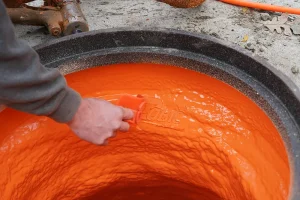
Having spent more than five years with ART, Isaiah has experienced nearly every aspect of underground infrastructure rehabilitation. Starting as a laborer immediately after high school, he advanced to foreman before joining ART’s Business Development team, giving him firsthand knowledge of both field installation and municipal infrastructure challenges. Today, he works with municipalities throughout Illinois and Indiana to develop rehabilitation strategies that extend infrastructure life while helping communities maximize limited budgets.
That commitment extends to every stage of a project. ART crews take pride in delivering high-quality workmanship, maintaining clean jobsites, and installing rehabilitation coatings designed to deliver long-term performance, not temporary fixes. As municipalities throughout Illinois and Indiana continue to invest in aging wastewater infrastructure, that combination of technical expertise, proven materials, and trusted partnerships helps communities protect critical assets for decades to come.
To learn more, please contact Isaiah at isaiah@artcoatingtech.com or 567-239-6034.
