When the City of Niles, Michigan, started looking at the condition of its wastewater contact tanks, replacement wasn’t really a practical option.
The plant didn’t have the extra space needed to build new tanks. And because the facility had to remain operational, taking both existing tanks offline wasn’t an option either. Replacing them would have meant building an entirely new system before the existing tanks could be taken out of service. So the city decided to rehabilitate the tanks instead.
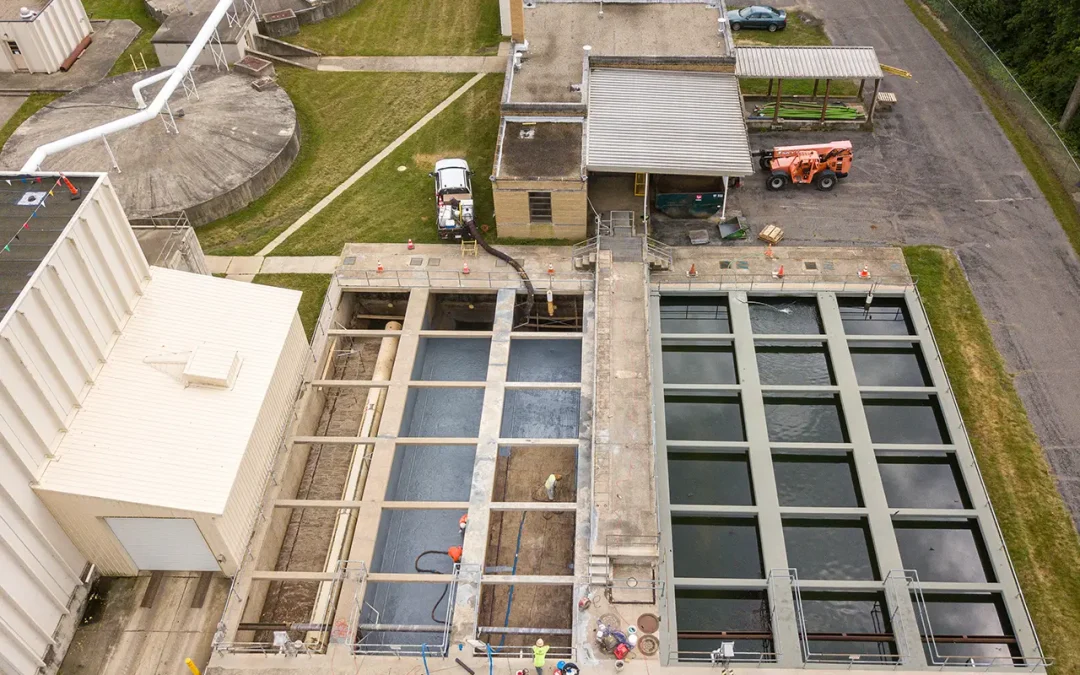
Advanced Rehabilitation Technology (ART) worked with Niles to develop a plan that allowed the work to happen one tank at a time. The city already rotated the tanks on a six-month schedule, so the rehabilitation work was coordinated around that schedule. That meant one tank could be taken offline, rehabilitated, and put back into service while the other continued handling the plant’s normal operations.
“The biggest thing was coordinating the work around the plant’s schedule,” said Alex Lantz, ART Business Development Manager. “We couldn’t just take both tanks down. We had to make sure the city could continue operating while we worked on each one.”
Once a tank was taken offline, the ART crew began preparing the existing structure. The failing floor lining was hydroblasted, concrete cracks in the overhead beams were repaired, and aging slide rails and baffle weirs were replaced.
Working on an open-top tank also meant keeping the work area dry. Weather could quickly become a problem, particularly when rain moved through the area. Careful scheduling and preparation helped the crew stay on schedule and keep the project moving.
After the concrete repairs and surface preparation were complete, ART applied the OBIC Armor System with a single layer of OBIC 1000 Polyurea.
The seamless coating provides a barrier against moisture and helps protect the concrete from the freeze-thaw cycles and continued exposure that can lead to deterioration. The finished surface also gives plant operators a smoother surface that is easier to clean and maintain than exposed concrete.
For Niles, the goal was straightforward: keep the existing tanks in service and get more life out of the infrastructure already in place.
The project also gave the city more flexibility from a budgeting standpoint. Because the tanks were rehabilitated on separate six-month cycles, Niles was able to spread the work across two fiscal budget cycles rather than taking on the cost of replacing the entire system at once.
“If you’re looking at any structure that has problems, being proactive and budgeting is a much better solution than trying to figure it out after a critical failure,” Lantz said. “Anything in a wastewater plant involves large dollars, so getting ahead of the game with early planning is crucial.”
The work has also opened the door for additional maintenance projects between Niles and ART. With the contact tanks back in service, the city and ART are already looking at other areas where rehabilitation can help extend the life of the plant’s existing infrastructure.
ART is an OBIC-certified installer and offers high-quality, long-lasting solutions for a wide range of applications. For more information about how we can help you, call 419-636-2684.
